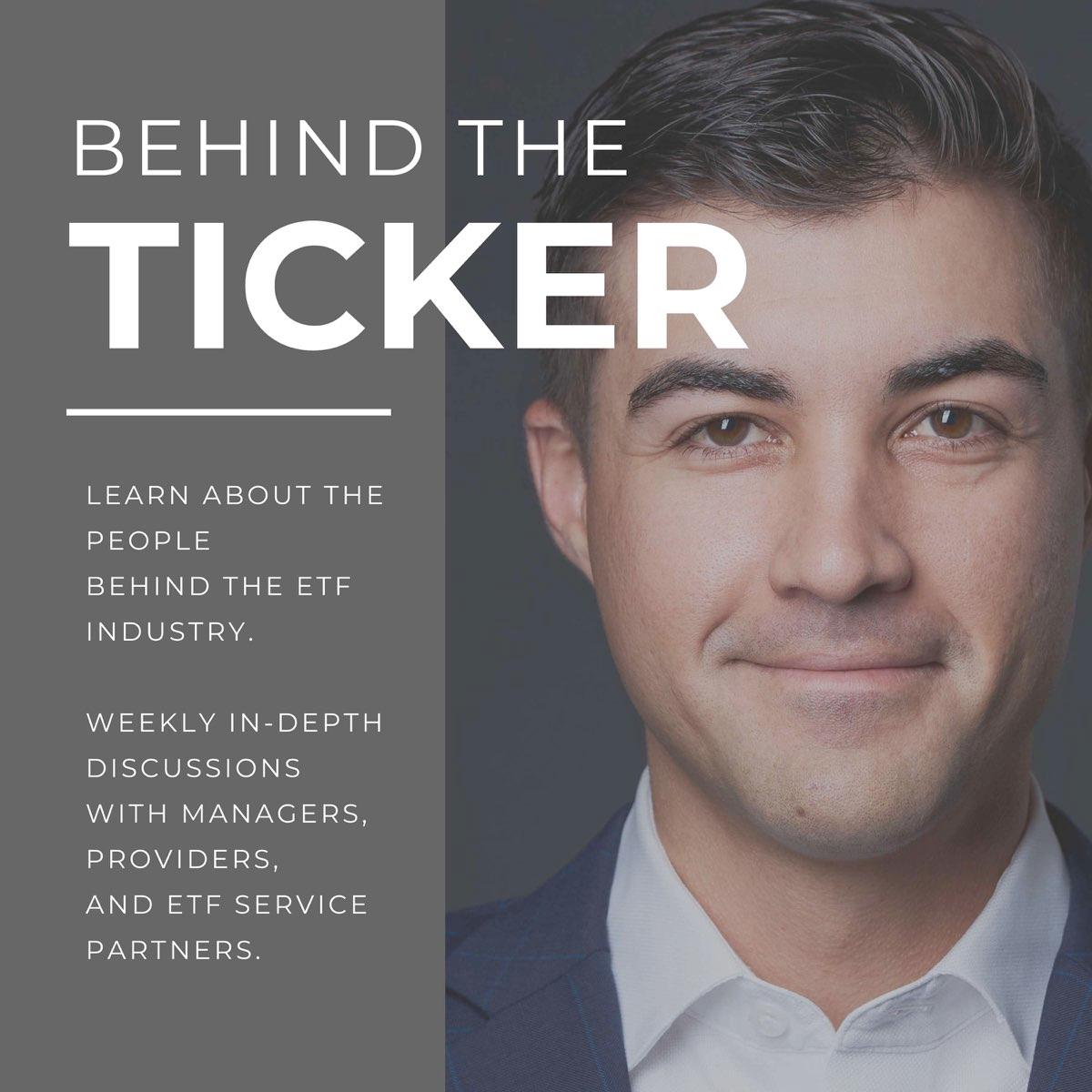
David Allen
All-Cap Value Energy: A Contrarian ETF Play
David Allen is the founder and CIO of Octane Investments, a firm focused on quantitative strategies with particular expertise in the energy sector. David has decades of experience in energy markets, quantitative trading, and systematic portfolio management. On this episode of Behind the Ticker, David joins Brad for a deep dive into how Octane approaches energy markets through quantitative models, why commodity markets have structural inefficiencies that equity markets don't, and how energy exposure provides genuine portfolio diversification.
Building Quantitative Models for Energy Markets
David explains that Octane was built around a specific insight: energy markets have unique characteristics that make them particularly well-suited to quantitative approaches. Unlike equity markets, where thousands of analysts cover the same stocks and information is rapidly incorporated into prices, energy markets have structural inefficiencies driven by physical supply and demand constraints, storage costs and capacity limits, weather patterns, transportation logistics, and geopolitical factors. These real-world frictions create persistent dislocations between price and fundamental value that systematic models can identify and exploit.
Octane's models analyze multiple data streams simultaneously. On the fundamental side, they're tracking inventory levels, production data, refinery utilization, pipeline flows, and demand forecasts across multiple energy commodities. Technical signals capture momentum, mean reversion, and volatility patterns. Macro indicators provide context for the broader economic environment. David emphasizes that the firm doesn't try to predict oil prices six months out. They look for shorter-term dislocations where data suggests price is diverging from value, with holding periods ranging from days to weeks and risk parameters built into every position from inception.
Why Energy Markets Are Fundamentally Different
David makes a compelling case for why energy markets behave differently from equities. In stock markets, correlations spike during crises and the overall market moves together. Energy commodities can move in completely opposite directions based on their specific supply and demand dynamics. Natural gas can crash while crude oil rallies. Refined product spreads can move independently of both underlying commodities. Geographic basis differentials between WTI in Cushing and Brent in Europe create yet another dimension of potential return.
This creates what David calls a "multi-dimensional playing field." Octane trades across directional positions, spread relationships between different commodities, term structure dynamics (contango versus backwardation), and relative value between geographic pricing benchmarks. Each dimension offers return streams largely uncorrelated to each other and to broader financial markets.
David also highlights seasonal patterns. Heating season drives natural gas demand in winter, driving season boosts gasoline in summer, and cooling demand creates electricity price spikes. The patterns are well-known, but their magnitude and timing vary each year. The quantitative models add value by calibrating position sizing to current conditions rather than mechanically following historical averages.
Portfolio Diversification That Actually Works
Brad and David discussed where energy exposure fits in an advisor's portfolio. David argues that most portfolios have minimal direct commodity exposure, even if they own energy stocks through broad indices. The return profile of energy commodities is fundamentally different from energy equities. Commodity prices respond to supply and demand fundamentals. Energy stock prices are influenced by management decisions, capital allocation, dividend policies, ESG sentiment, and broad market beta. Owning Exxon is not the same as having commodity exposure.
David points to 2022 as the defining example: stocks and bonds both fell significantly, destroying the diversification assumption behind the 60/40 portfolio. Energy commodities rallied sharply in the same period. A systematic energy allocation would have provided meaningful portfolio-level protection when traditional diversification failed. That non-correlated return stream is what alternatives are supposed to deliver, and energy commodities actually do.
The firm's approach to risk management is worth noting. Every position has predetermined stop losses and position sizing rules built in from the moment it enters the portfolio. David doesn't wait for a position to "come back." If the data says the thesis is broken, the position gets cut. This discipline, combined with the multi-dimensional approach across different energy sub-markets, means the portfolio can generate returns in a wide variety of energy market environments rather than depending on one commodity moving in one direction.
David also discussed the evolving energy space. While the narrative around renewable energy transition dominates financial media, the reality is that global energy demand continues to grow, and hydrocarbons are meeting the bulk of that incremental demand, particularly in developing economies. The investment opportunity in traditional energy is far from over. Octane's quantitative approach allows the firm to be agnostic about which energy source "wins" and instead focus on where the data shows the best risk-adjusted opportunities at any given time.
Key Takeaways
- Octane Investments uses quantitative models to trade energy markets across multiple dimensions: directional, inter-commodity spreads, term structure, and geographic basis differentials.
- Energy markets have structural inefficiencies driven by physical supply/demand, storage, weather, and logistics that create persistent opportunities not available in more efficient equity markets.
- Energy commodity returns are fundamentally different from energy stock returns. Owning Exxon is not the same as having commodity exposure, and the two serve different portfolio roles.
- In 2022, energy commodities rallied while stocks and bonds both fell, demonstrating the genuine diversification value that most traditional portfolios are missing entirely.
- Seasonal patterns in energy create recurring opportunities, but Octane's models add value by calibrating to current conditions rather than following historical seasonal averages.
Listen to the full conversation on Spotify, Apple Podcasts, or YouTube.
Full Transcript
5,769 wordsMachine transcribed from Brad Roth's conversation with David Allen, with speakers identified automatically. Timestamps link to that moment on YouTube. Lightly cleaned, otherwise unedited.
Behind the Ticker is brought to you by UX Wealth Partners. If you're a TAMP user and you're sick and tired of the legacy technology they are run on and you want more customization and flexibility, as well as an AI-driven model marketplace, UX Wealth Partners is your destination. On top of that, they have institutional trading. So if you are an ETF issuer or an SMA provider looking for outsourced institutional trading, UX Wealth can also be your destination. So check out uxwp.com to find out all the ways UX Wealth Partners can help grow and make your practice more efficient.
Welcome to Behind the Ticker. Today we have on David Allen. He is the founder of Octane and we are talking about their all-cap value energy ETF, ticker OCTA. It is a fund structured around an all-cap value strategy, investing in energy companies with stable earnings, strong balance sheets, and a commitment to returning capital. We talk about the opportunity in the energy sector. There's been a lot of focus on sustainability and renewable energy. And while those are important, David and I both are on the same page when it comes to seeing that there is still a ton of opportunity in traditional energy sectors and how there is an under-allocation in broader indices to this particular sector.
So without further ado, please welcome Mr. David Allen. Hey, David. Welcome to the show. Good morning, Brad. Thanks so much for having me. Great to be here. So before we get started, I always like to ask, can you tell everybody about your background, how you got into this, and how eventually you went out and started Octane Investments? Thank you. It's great.
I will date myself a little bit. I noticed that you went to Duquesne University. So in 1992, I was a dollar-deutschmark trader at a place called Merrill Lynch. And it was a really good trading desk. And I was there when Stanley Druckenmiller and George Soros broke the Bank of England. Now, way back when, there were only about $25 or $30 billion in hedge fund assets. And that day, they made a billion dollars for their LPs by breaking the Bank of England. We thought it was all the money in the world. And today, hedge fund assets, depending how you count, are $4 or $5 trillion.
Read the full transcript (63 more sections)Collapse transcript
So I sort of fell in love with geopolitics way back when and started watching crude, obviously, with intent back then and even in the 80s when I was in college.
So what kind of led you from those experiences to kind of decide to go out on your own and start the firm?
Well, I saw gigantic opportunity. I saw gigantic vacuum in the market created mostly by divestment. So when you look at, there are a lot of allocators, a lot of public funds in the U.S. They started divesting from, let's say, thermal coal and Canadian tar sands. And eventually, they started getting out of all of traditional energy stocks. And the way they count it and the way the U.N. pension, for example, counts it is scope one and scope two emissions. So by rough calculation at Octane, when you add up the people who signed up for the Paris Accord, plus on the buy side, people who have signed up for GFANs, you're talking about $50 to $60 trillion who have either divested or planned to divest in the next 10 years.
And what that does is it creates a real vacuum. And that's one of the premiums that Octane is meant to gather for investors, which is the carbon risk premium. And on top of that, there are other risk premiums. There's obviously the equity risk premium. There's the small cap premium. We are an all cap value shop. And of course, the value premium. So this, we think there's a gigantic white space in the market. We don't want to see a world in which there's no traditional energy. I think Jamie Dimon himself told Congress that it would be a hellscape if we lived in a world without the ability to burn hydrocarbons. And so I launched the firm as a pure reaction, a market reaction to this dearth of capital that's going to these publicly traded companies.
So before we get too into the weeds on the energy sector and the ETF, what do you like to do when you're not working, when you're not behind the desk? Any hobbies, things you love to do? Absolutely.
Summer is when I'm not doing such things as launching an ETF. And I see that you launched one a few days ago. Congratulations. I rent sailboats out of Newport, Rhode Island and take one or two or three weeks. It's called bare boating when you rent a sailboat and you don't need a skipper because I'm the skipper. And it's just fantastic. The year 2020, I had a sailboat for the entire month of August. And that's a lot of fun. And the other thing, I am a bit of an amateur writer. I had a screenplay that apparently got to the head of a major studio. And then the pandemic happened and I didn't hear from them again. But I've really learned a lot about structuring a story.
And I think that's going to help me as I roll out the CTF and start marketing it.
That's great. So you're the first screenwriter we've had on. But it's funny. I had on Nancy Davis from Quadratic. Her episode will be actually coming out. They've already heard it by the time they hear yours. She runs iVol. She's an avid sailor too. I had on Katie Stockton. She's an avid sailor. I'm trying to create a correlation between ETF issuers and sailing because it seems like it's the biggest hobby in this business for some reason. That's cool. Well, there's something about... Sorry, go ahead. No, I was going to... I just... I've never done it. I think... Well, I shouldn't say I've never done it.
We rented a house in Jamaica 10 years ago and I had one of those little dinghy sailboats. I made it probably 25 feet. But it is fun. And I think I would love to learn to do it.
Well, I think you would take to it as a fish takes the water because when you're sailing, you're at the helm or you're skippering a boat. It could be with one passenger or it could be just you. And I sailed for eight years in the bay. I was out in San Francisco with Alliance Bernstein for eight years. It's a lot about risk management and it's a lot about being in the flow of things. And it's interesting. There's an old expression in sailing. When do you reef the sails? In other words, when you depower the sails. And the old saw is you depower the sails as soon as you think of it. And I sort of... I'm in a very wildly volatile market now. If there's an upstream company that has maybe a little bit more debt than we would rather have, then it's probably time to trim.
So it's interesting. Trim. There's another corollary word to sailing. But I think you'd love it and you should let me know when you're out here.
Yeah. No, that would be great. So let's get back to the company. So Octane, you have a single issue ETF right now, OTCA, which we're going to talk about in depth today. But the fund is fairly new. So can you talk about why you went the ETF route and a little bit about your experience launching the ETF from kind of ideation to launch? Because it's fresh in your mind. And it is a big undertaking. Yes.
Thanks for asking. So I came up with the idea about three and a half years ago when these... And I was in institutional sales at my last job. And last time I traded and took risk was the first third of my career when the FX market was truly volatile. And I learned a lifetime doing it then. But some of the biggest clients that I had, mainly East Coast public funds, were going wholesale out of traditional energy companies. And, I'd have these long and polite, respectful conversations with them to say, okay, you know the reason the U.S. has a smaller footprint today.
Let's call this 2021. The reason the U.S. has a smaller carbon footprint today than in 2005 is because of these companies that you're selling. You're selling these companies. They're trading at six and a half price to earnings. They're making a lot of money. Wall Street got smart about sending blind money to the oil patch after 2015, 2016. There were tens of billions of Wall Street dollars went down. These were the pioneer days of Aubrey McClendon. And they bought really expensive acreage. And all they cared about was production. And, a third of them went out of business. There was a knife fight between the Permian and the Saudis in 2015, 2016.
The second episode happened during the pandemic. And I wasn't really interested in the space until after the pandemic. When the C-suite in the oil patch actually got real about returning capital to shareholders. So it's interesting you asked me the question. I was doing my homework. I was still at my other firm. And I would call these quants that I know a lot of them. I currently serve as chair of the CFA Society of New York. We have 11,000 members. We were co-founded by Benjamin Graham in the 1930s. And I called these quants. And I said, here's what I want to do.
I want to have a long-only equity portfolio. I think I want to do all cap value. And we can talk about that too. The utility and efficacy there, Brad. And I would call them and they say, well, yeah, we can put something together. We'll have some coders put together. And I said, I don't want a black box for a couple of reasons. First of all, 2 Sigma or BlackRock can invent something much better overnight and update it a lot better. And more importantly, I can't sell a black box if I didn't design it. So I went back to the very basics and I built a very simple decision tree. And the decision tree may be something like what you'd build if you had a greenfields approach to investing in the energy sector.
The first node is PE. We want relatively stable E and a cheap P. So that's the first basket. We get a data feed from Empirical Research Partners. It's a curated data feed on about 170 names that trade in the U.S. We buy ADRs, but only of developed world companies. So however much I'd love to be in Petrobras for their gorgeous field, I don't want to lose 500 basis points overnight if the people in Brazil change their minds about Petrobras. So with that all cap value approach, the first decision tree node is price to earnings.
We want cheap price to earnings. The second is probably the most important node, which is do they have a strong balance sheet? Now, by definition, Brad, all of these companies are price takers, right? So if you're an upstream company, you're selling into a commoditized market, very volatile commoditized market. If you're a refiner, you're selling into a wholesale gasoline or diesel market. Then the third decision tree, which is really important as well, and I alluded to this before I started the business, I wanted to make sure that the oil patch companies were doing this. The third decision tree is, are they returning capital to shareholders? And what we've seen is most of them have, one way to do that is to bring down share count.
Another way, obviously, is to eliminate debt. we have some companies in the portfolio that had, 40%, 50% debt to equity, and now they're actually have negative debt. In other words, they have paid down almost all their debt, and they have excess cash on their balance sheet. These are really nice situations to be in, and it's also a situation where they can really weather the commodity storm. And let me just go back to, I mentioned the upstream. I also mentioned refiners. If I were describing what we do to an Aunt Sally who doesn't have a PhD in finance, I would say, you may have a great company, large cap integrated company, oil company, that's trading at 13 or 14 times price to earnings.
It probably should be there. It probably should trade at a premium. What we're trying to do at Octane is replicate or at least approximate the financial exposures of that company, but do it piecemeal. And I wrote a white paper on that called Somewhere Under the Radar. And that's not about energy, but it's about the most important thing that I think has happened in my career, which is the rise of passive. So I grew up eight minutes from Vanguard's headquarters in Valley Forge. And in Somewhere Under the Radar, I talk about a widget conglomerate that's trading at $100 billion market cap. It's in every big index. When the German pension fund buys a global equity beta through MSCI World, they're putting, 80 cents into this widget conglomerate.
But the widget conglomerate, you can replicate their business by taking pieces of that and putting them together. So what I've manufactured in this 30-stock portfolio at Okta, and it is probably more volatile than your integrated company. But what I've done is I've taken the cheaper pieces, put them together so that there is some modicum of balance in the broader portfolio while getting a major discount to the mega caps that have been driven up from this passive active world that we live in.
So I'm glad you used the term under the radar because this is one of the questions I have. Can you talk about how your team is finding and deeming these companies under the radar? So you went through your three nodes. I'm assuming you have a screening process to get to your 30, and then you deem them under the radar by them being stable earnings and the price is just really attractive. Is it really that simple?
It's pretty simple, but there's a little bit of art above the science. Let's say we start with about 170 names. These are traded in the U.S. They are north of a billion dollars. And, of course, we weed out the non-OECD companies. And so let's say we start with about 150 names. We try to take the top roughly one-third of those names from a forward P.E. ratio and from an intrasectoral valuation. And so let's say we come up with – call it 50 or 60 names. And then we do the debt-to-equity test.
Now, this is where a little bit of art comes into the science because if we're looking at six or seven subsectors, if you have, let's say, a scale refiner, a household name refiner that ends up in, for example, cows and other successful ETFs, great cash flow, great buybacks. You probably know that they're building a lot of refining capacity in China and even the Middle East. But here they're not building any more refiners. California wants to either take theirs over or have them go away. I'm not sure where they're going to get their fuel, but that's beside the point. So within these different subcategories, you basically get a feeling for what sort of debt load they can handle.
So a refiner with all that in-the-ground equipment sort of irreplaceable from a footprint standpoint can actually take on more debt than a pure upstream play. So we're looking at relative debt-to-equity ratios within subcategories. The other thing that we try to do, we try to lean into categories which we think are very stable and can do really well even if crude suffers. So today is a really good example. Crude is down about 3%. And we are kind of flat. And the reason we are is refiners have a bid to them today. Why?
If you have a soft upstream cost, your crack spread looks relatively decent. The other thing we've gotten into as really a picks and shovels play is we've got about a 15% exposure to tankers. Now, it's really funny. Mr. Market, I know you know this, Brad. Mr. Market is omnipotent but not omniscient, right? So when crude is falling out of bed, Wall Street in general sort of hates all the broad category. But when you look at, okay, if you've got a six-month, a nine-month, a 12-month time horizon, which we certainly do, certainly anybody buying these ETFs should have an equity-like time horizon because this stuff can be volatile.
We look at if you've got soft commodity prices for the hydrocarbons, that's really good for tankers. Why? Because the arb of getting the stuff from Shrevesport, Louisiana to mainland China or even to Indonesia, the arb goes higher and the tankers will make their money. The other thing about, if you've been through a couple of capital market cycle, the thing that destroys tankers margin is an overbuild. We don't believe there's an overbuild in that category. So the tankers is a beautiful place, both clean and dirty, where we've put, as I said, 15% of the portfolio. We also have 16% in coal.
As Australia and the UK are winding down and shuttering their very last coal plants, China has 300 brand-new coal facilities on the books, and these will have at least 40-year lives. Brad, we still get about 10% or 11% of our grid that's powered by coal. I know we're retiring them, but if we spend a little bit more money, we can scrub them, make them a little bit cleaner. So we still like coal. The developing world is – to the developing world, coal is the hydrocarbon of their future. And I'm not saying that tongue-in-cheek. It's just a fact of life.
And one more thing about – when you look into the microeconomics of these companies, there's one holding that we have that just six years ago, two-thirds of its business was domestic and one-third seaborne thermal coal. They flip that on its ear. So these people aren't dumb. They see the retirement of these coal plants, and they're cash flowing just beautifully, paid down almost all their debt. So there's some really cool stories when you open up this broad category that the world seems to hate. And the other thing, I published a video yesterday on how behavioral finance – when you tack on the idea of behavioral finance into the sustainability movement and GFANCE, which is Glasgow Financial Accord for Net Zero, it's not going to happen.
And about 30 blocks away from me at the UN, there are a bunch of dignitaries that flew in on big fancy jets, and they're talking about how, the plumber in Ohio shouldn't ride around in a big diesel truck. And it's a bizarre thing. One more thing, if I may, about sustainability. I know the UN pension very well. In fact, one of my advisors at Octane, and he's up on the Octane website, octane.nyc, was the former head of sustainability at the $80 billion UN pension plan. And we're trying to be very apolitical at Octane. It's hard sometimes. We really try to be. The odd thing is, all the people sitting – it's climate week here in New York, and everybody's here for the UN General Assembly next week.
We talk – a lot of people talk about the United Nations principles for responsible investing and the United Nations 17 sustainable development goals. And it's not a trick question, but I ask these people, and I run into them all the time, do you remember what the number one SDG is, the number one sustainable development goal of the United Nations is? I'll tell you what it is. It's reduced global poverty. Now, if somebody can reduce global poverty and end fossil fuels, that would be a wonderful miracle. It's not going to happen. It's not going to happen for another 90 years. I hope technology happens, but it's not going to happen now, which is why we're quite comfortable, for example, with a 16% exposure to coal.
Yeah, I agree with that entire sentiment. Plus, I have a couple coal broker buddies that do well, and I like to see their businesses continue to grow. So – Nice.
Nice. Brad, can I – I want to ask you a question. I'm going to interrupt right in the middle. I want to flip the script, if I may. So congratulations. I'm pretty sure you launched your second ETF and index rotation ETF on Monday.
Was it this week? It was – And this will probably air later, but God.
Yeah. Well, I just – Please, you're generous to have me on. I'm going to flip the script and ask you, can you give us the – what's the 90-second sort of elevator pitch and why are you excited about the launch?
Well, thank you for the airtime. I'll take the airtime. We're really excited about it because we build portfolios for people that are very simple for them to explain to their clients. And this is probably our most simple strategy that we've ever put together, which is it invests equal weight in the big three indices, SPY, the Dow, and then the Nasdaq 100, better represented by QQQ. It's an equal weight exposure. Right. We run our models over top of those three names. So in periods of time, you might get a value tilt. In periods of time, you might get a growth tilt. But our big belief here is we're a low-vol manager and we're risk managers.
And if things get ugly in volatile periods, we have no problem moving into cash or parts of the portfolio into cash-like instruments or money markets. And so we want to give the advisor an ETF option, both for market cap weighted indexes like THIR is, the index rotation, and like our other ETF, THLV, which is an equal weight sector approach. To kind of pair it along their large cap equity exposure and know that there are kind of true low-vol products that can help turn down the volatility quite dramatically in periods of volatility. The only reason we built the suite, we brought it out to market is because traditional low-vol, I'm not picking on anybody, so I'll pick two.
But the two big titans, your USMVs and your SPLVs in the world, if you look at 2020, if you look at 22, they experienced the same drawdown as the S&P. And that's not what people think low-vol is. Low beta seems to be acting. Beta doesn't matter, in our opinion, when the market falls apart. It seems that everybody dumps everything anymore. And so that's really what the product is. Correlation of one. Yeah, yeah, it really turns into a correlation of one. And so we, yeah, we're excited about it and hope to, we've had some success early. I think we've, it's been out for 48 hours now. There's about 17 million in there and hoping to get this thing chumming along.
And yeah, so we're excited.
That's really nice. So let's say you're talking to a $2 billion RIA. Is this a six-month buy or does this earn a, is your hypothesis that it earns an almost quasi-permanent place at the $2 billion RIA that's generally 60-40?
Yeah, we believe it deserves a quasi-permanent place as a satellite to your large cap equity investments. And we think holding both makes sense because we're in a period now where, market cap weighted indexes have absolutely blown the doors off of equal weight, right? But you and I both know that equal weight at some point will come back, outperform market cap weighted and kind of get that. So I like both exposures, but we like to kind of satellite it in there. If you're holding SPY, if you're holding DIA or if you're in the Vanguard suite, right? You're just holding the S&P or large cap, which a lot of people do. We think it's a quasi-permanent holding to just bolt on.
I don't think timing our products is the right thing because if you can time, then you might as well do what we're doing yourself. I think the vast majority of the time, our products are fully invested. So it's not like, these things are turning off the off switch a lot. They're going to turn off the off switch when, markets are going to go through that like snap drawdown 15, 20, 25, 30%. That's when you're really going to love us.
It sounds really cool. It sounds to me, just bringing back the sailing analogy, that this is good ballast, sort of active ballast. And when your, S&P 500 exposure looks really top heavy with big tech, that your ballast can have a real stabilizing factor to the rest of the portfolio, rest of the equity beta.
It's exactly how we view it. We don't view us as a holistic. We view us as, hey, blend us in with everything else that you're doing. We fit nicely in a diversified portfolio. And we can, these models have been out since, 2019 running in SMAs. And so we have some cycles in there, right? We've got 2020. We've got 2022. 2022. And they hold up well and do what they're supposed to do. So I appreciate you, you flipping the script on me, but we're going to go back to OTCA because I have a couple more questions. We're coming up on time here a little bit. So I want to make sure we, we get to them. Really quickly, we talked about how you're, you're running the screen.
How often are you rerunning the screen? Is it an annual, is it an annual screen? Is it a month? Like how often are you kind of re-scrubbing your list? Weekly. Weekly. Okay. Yep.
And then. Weekly. And then of course we look at prices all the time. Yeah.
And the fund is all cap. So what is kind of, I know it can change, especially with a weekly screen. Is there kind of a mix that you're looking to achieve in terms of small, mid, large cap? Like how does the, how does the underlying kind of fit in that mix in your all cap portfolio?
Well, it's, it's a great question. And speaking of ballast, we've had, it's been really good to own. We talked about other risk premium. There's a European risk premium right now. And so we own three of the European integrators. You probably saw one of the, one of the, one of the big continental integrators about two months ago talked about actually listing on the New York Stock Exchange. And so with an all cap value lens, we've, we've, it's been really good getting some cheaper ballast from the European mega caps, which perennially traded 25 or 30% discount to the excellent US integrators.
And the other cool thing about the value lens is, is look on, look on Morningstar Pro, who owns what, and there's a company called Oxy. We don't own it. It's no longer a value stock. And you look at all the, the, the, the one organization is buying it. It's Berkshire Hathaway. Right. And chase it up to about, I'm not sure what it is, maybe 13, 14, 15 times price to forward earnings. And you see all the huge, all the large cap value managers, Dodge and Cox, all the great ones go just do this step down function. And because Berkshire Hathaway is so big, what are they a trillion dollars that they just, anything they touch is no longer value. It's a very, very interesting dynamic.
But, but to your, to your point, we're sort of agnostic as where we, where we lie in all cap. there, there really are a lot of opportunities. And speaking of all cap, and I asked you what your hypothesis was for THIR. I think we've got more than a hypothesis. It's not easy, but it's simple. There are $38 billion of holders of the XLE. And the XLE, as is, is the subset of SP500 and energy. And Okta was built to be the little brother of your XLE allocation. And so we were talking to RAs now, they've got big allocation to XLE because they recognize a systematic and structural underway to energy.
And most of my career since 87, it's been between, let's call it six and 16% of the SP500. In 1980, it was 27%. And today it's less than 3.7%. And you can't have a conversation on Wall Street without talking about AI data centers. I'm sorry, these things don't run on windmills. I'm sorry, UN. They don't run on windmills. So we need more and more traditional energy. I love nuclear. Nuclear does not, it's not, it doesn't have a place in this portfolio now. However much I love nuclear. But if you hate, if you hate carbon in the atmosphere, you got to love nuclear. But it's sort of a long winded way of saying the opportunities are great because we can't build big tech without cheap, dependable, reliable energy.
So we think it's a nice tailwind for us. And the structural underweight is something, again, apolitical. A lot of people out there in RIA land and even institutional allocator land acknowledge they want to get that beautiful, cheap beta exposure to U.S. growth. It comes with a cost, right? You may have gaps in your portfolio. So we don't think energy is thematic. We think it's fundamental. And we think that most people out there have a structural underweight.
Yeah, no, I agree. I was kind of reading some of that stuff on your website. I had questions about that. So I'm glad you touched on it. My last question about the fund itself is how are you approaching kind of the weighting decision? It doesn't look like it's pure equal weight, but it looks like some of these are pretty close. And so I guess what's your methodology around portfolio weighting? Yeah, that's a key question.
And it's a big differentiator again to the Exley. If I talk to somebody who owns Exley, the first thing out of their mouths is, yeah, we like it, but it's 40% in two names. By the way, those are great names, but it's 40% in two names. So by design, we have a 500 basis point initial position limit and an 800 basis point limit. And it's not that we really want to be so equal weighted, but we think if we're trying to approximate these big, rich integrators, we want a lot of micronutrients. And because also we're dealing in all cap, we're going to get a lot of mid cap and small cap names and their cost of capital is higher.
And when crude gets ugly, when cost of borrowing goes up, those are more volatile than others. So we really did want to tamp down idiosyncratic risk. And by doing that, we have the ex-ante limit of 500 basis points when we put on a new position. Does that make sense?
Yeah, it makes a ton of sense. So I guess, last question.
Yeah, yeah. We'll also leg into something, right? So the market could really hate something. It could really hate, let's say, a mid cap refiner for whatever reason. None of us like to catch falling knives, but with a value lens, which we think is kind of unique in the energy space. With a value lens, we can catch butter knives. A butter knife is, let's put 75 basis points on. This thing is going, this thing's down 12% in a week. Let's put a 75 basis point position on. And then it goes sideways. Let's put another 75 basis points on. the Druckenmullers of the world know that you can leg into a position as long as the market's agreeing with you.
Now, let's say we've got 300 basis points. It looks a little bit more big that we can complete with the other 200 basis points. So, and the flip side is true also. we can let the market come to us. And what's crazy about the way the market's trading with momentum, we've owned stocks in a separate account for the ETF that have reached like a little bit beyond our price target. We've sold all of it. And I think, the 0.72s and two sigma get a hold of the momentum and it goes up another 20%. You just sit there and say, well, if we had a long short fund, we'd probably be selling now. But the market's so much fun.
Every day is different.
I know you know that. Yeah. So, David, I really appreciate your time. I thank you for being with me today. Before I let you go, where can people learn more about the firm and learn more about the ETF? Thank you so much.
Please go to our website. It's octane.nyc. You can also find me on LinkedIn, David Allen CFA. I'm pretty sure I'm the only one there. And I've got a couple of videos up there and stay tuned to the website. We're going to add a lot more. And we've got some research coming out about wastewater in the Permian, which we think will be interesting news in the next week or two. Thanks for having me. Really appreciate meeting you. Yeah. Thanks, David. And good luck with THIR.
Thank you so much. We'll see you soon. Thanks, Fred. Bye. Bye. Bye. Bye. Bye. Bye. Bye. Bye. Bye. Bye. Bye. Bye. Bye. Bye. Bye. Bye. Bye.
Bye. Bye. Bye. Bye. Bye. Bye. Bye. Bye. Bye. Bye. Bye. Bye. Bye. Bye. Bye. Bye. Bye. Bye. Bye. Bye. Bye. Bye. Bye. Bye. Bye. Bye. Bye. Bye. Bye. Bye. Bye. Bye. Bye. Bye. Bye. Bye. Bye.
Daily Market Intelligence
The Signal
Brad Roth's daily market brief — systematic signals, ETF positioning, and what the data is actually showing.
Subscribe Free →